

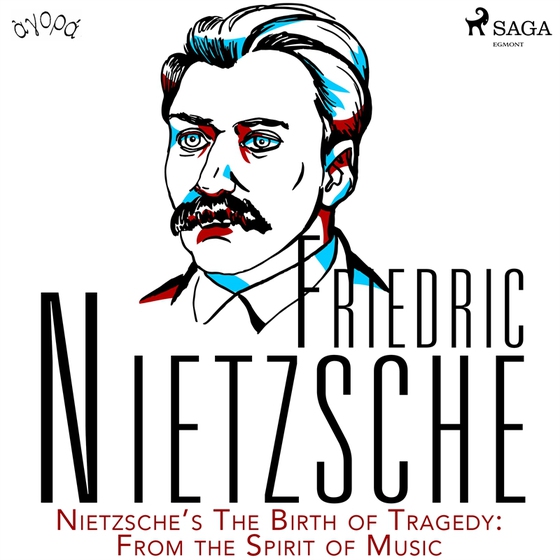
Friedrich Nietzsche
(författare)
,
William Sigalis
(berättare)
Nietzsche’s The Birth of Tragedy: From the Spirit of Music ljudbok
79 kr
"The Birth of Tragedy" stands alongside Aristotle’s "Poetics" as essential works for all who seek to understand poetry and its relationship to human life. In this, his first book, Nietzsche developed a way of thinking about the arts that unites the Greek gods Apollo and Dionysus as the central symbol of human existence. Although tragedy serves as the focus of this work, music, visual art, dance, …
"The Birth of Tragedy" stands alongside Aristotle’s "Poetics" as essential works for all who seek to understand poetry and its relationship to human life. In this, his first book, Nietzsche developed a way of thinking about the arts that unites the Greek gods Apollo and Dionysus as the central symbol of human existence. Although tragedy serves as the focus of this work, music, visual art, dance, and the other arts can also be viewed using Nietzsche’s analysis and integration of the Apollonian and the Dionysian.
Nietzsche opened the door to philosophy in the 20th century. He anticipated depth psychology, championed myth, attacked literalism in religion and the arts, placed humanity in an evolutionary perspective, and launched a critique of scientism that remains potent in the 21st century. Although he is often linked to the movement known as existentialism, Nietzsche’s overall work defies being placed in any single category.
Ljudbok
79 kr
E-bok
45 kr
Förlag
Saga Egmont
Längd
3:14
Genrer
Fackböcker, Filosofi Och Religion
Språk
English
Format
mp3
Kopieringsskydd
Vattenmärkt
ISBN
9788726425727
"The Birth of Tragedy" stands alongside Aristotle’s "Poetics" as essential works for all who seek to understand poetry and its relationship to human life. In this, his first book, Nietzsche developed a way of thinking about the arts that unites the Greek gods Apollo and Dionysus as the central symbol of human existence. Although tragedy serves as the focus of this work, music, visual art, dance, and the other arts can also be viewed using Nietzsche’s analysis and integration of the Apollonian and the Dionysian.
Nietzsche opened the door to philosophy in the 20th century. He anticipated depth psychology, championed myth, attacked literalism in religion and the arts, placed humanity in an evolutionary perspective, and launched a critique of scientism that remains potent in the 21st century. Although he is often linked to the movement known as existentialism, Nietzsche’s overall work defies being placed in any single category.
Inga recensioner än