

Ivan Escö
(författare)
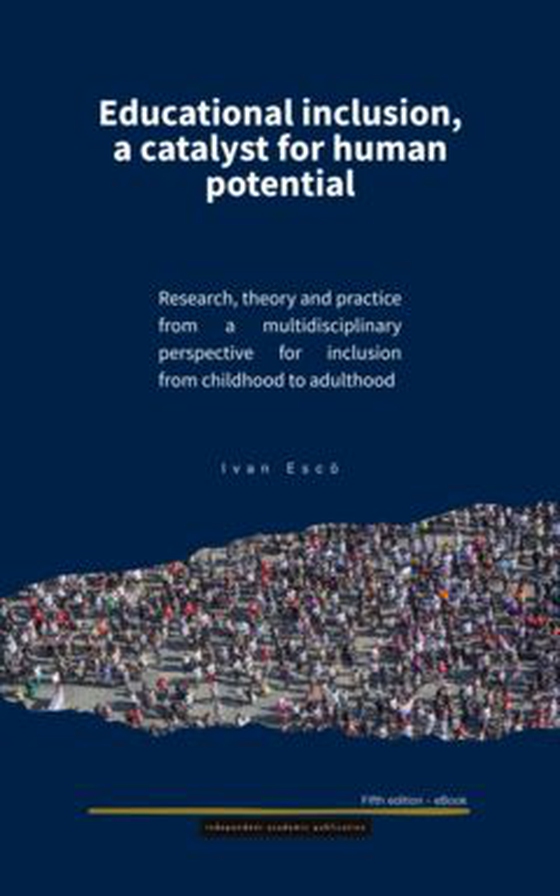
Utbildnings-inkludering: en katalysator för människans potential e-bok
Gratis
Inclusive education has advanced considerably over recent decades, particularly in promoting the rights of persons with disabilities and fostering more accessible educational environments. Yet the challenges of the twenty-first century extend far beyond disability alone. They call for a broader understanding that human diversity is an inherent characteristic of every individual and should be reco…
Inclusive education has advanced considerably over recent decades, particularly in promoting the rights of persons with disabilities and fostering more accessible educational environments. Yet the challenges of the twenty-first century extend far beyond disability alone. They call for a broader understanding that human diversity is an inherent characteristic of every individual and should be recognized as a fundamental principle of education.
This book is founded upon that conviction, shaped by two defining dimensions of my personal and professional journey: my experience as a student and my career as an entrepreneur in the field of inclusive education. Together, these experiences have led me to recognize that, while educational policies have made substantial progress in supporting students with physical, cognitive, and sensory disabilities, a significant proportion of learners whose differences remain invisible within conventional educational systems continue to be overlooked.
Students with high intellectual abilities, exceptional talents, outstanding creativity, divergent thinking, diverse cognitive profiles, distinctive learning trajectories, and multiple ways of understanding the world frequently encounter barriers that arise not from their own limitations but from educational systems designed around a standardized conception of the learner. In many cases, exclusion results not from deficit but from the inability of institutions to recognize, value, and cultivate individual strengths.
This volume seeks to broaden the concept of inclusive education through a multidisciplinary, interdisciplinary, and systemic perspective. It brings together insights from pedagogy, neuroscience, psychology, sociology, anthropology, philosophy, history, economics, educational leadership, technology, artificial intelligence, and the learning sciences, integrating them with empirical evidence, professional experience, and humanistic reflection.
Its purpose is not merely to examine disability but to explore human diversity in its fullest expression, acknowledging both the support needs and the exceptional capacities that may be present in every learner.
The very structure of this book reflects that philosophy. Across seventeen chapters, readers embark on a journey that begins by challenging the paradigm of the "ideal student" and the standardization of education. It then examines the biological, cognitive, psychological, social, historical, and cultural foundations of human diversity, critically explores the hidden costs of educational exclusion, and develops a multidimensional framework of inclusion encompassing disability, neurodiversity, mental health, medical conditions, linguistic, cultural, identity-based, social, contextual, and learning diversity, as well as exceptional talents, individual abilities, and systemic barriers.
The discussion then turns to the transformative impact of digital technologies, artificial intelligence, and emerging models of learning, before ultimately connecting inclusion with human evolution, cooperation, innovation, collective intelligence, systems thinking, institutional leadership, and sustainable social development. The volume concludes with practical recommendations for educators, families, educational institutions, and policymakers, together with an interdisciplinary framework that synthesizes the principal contemporary scientific perspectives on inclusive education.
This book offers a comprehensive multidisciplinary perspective on inclusive education for educators, researchers, educational leaders, and policymakers. It invites readers to recognize human diversity not as an exception to be accommodated but as the very foundation of learning, innovation, human development, and social progress in the twenty-first century.
E-bok
0 kr
Undertext
Forskning, teori och praktik ur ett tvärvetenskapligt perspektiv för inkludering från barndom till vuxenliv
Utgiven
01.07.2026
Längd
547 sidor
Genrer
Ungdomsböcker, Samhälle Och Politik, Humaniora, It & Teknologi, Psykologi Och Pedagogik
Språk
English
Format
epub
Kopieringsskydd
Vattenmärkt
ISBN
9789403912028
Inclusive education has advanced considerably over recent decades, particularly in promoting the rights of persons with disabilities and fostering more accessible educational environments. Yet the challenges of the twenty-first century extend far beyond disability alone. They call for a broader understanding that human diversity is an inherent characteristic of every individual and should be recognized as a fundamental principle of education.
This book is founded upon that conviction, shaped by two defining dimensions of my personal and professional journey: my experience as a student and my career as an entrepreneur in the field of inclusive education. Together, these experiences have led me to recognize that, while educational policies have made substantial progress in supporting students with physical, cognitive, and sensory disabilities, a significant proportion of learners whose differences remain invisible within conventional educational systems continue to be overlooked.
Students with high intellectual abilities, exceptional talents, outstanding creativity, divergent thinking, diverse cognitive profiles, distinctive learning trajectories, and multiple ways of understanding the world frequently encounter barriers that arise not from their own limitations but from educational systems designed around a standardized conception of the learner. In many cases, exclusion results not from deficit but from the inability of institutions to recognize, value, and cultivate individual strengths.
This volume seeks to broaden the concept of inclusive education through a multidisciplinary, interdisciplinary, and systemic perspective. It brings together insights from pedagogy, neuroscience, psychology, sociology, anthropology, philosophy, history, economics, educational leadership, technology, artificial intelligence, and the learning sciences, integrating them with empirical evidence, professional experience, and humanistic reflection.
Its purpose is not merely to examine disability but to explore human diversity in its fullest expression, acknowledging both the support needs and the exceptional capacities that may be present in every learner.
The very structure of this book reflects that philosophy. Across seventeen chapters, readers embark on a journey that begins by challenging the paradigm of the "ideal student" and the standardization of education. It then examines the biological, cognitive, psychological, social, historical, and cultural foundations of human diversity, critically explores the hidden costs of educational exclusion, and develops a multidimensional framework of inclusion encompassing disability, neurodiversity, mental health, medical conditions, linguistic, cultural, identity-based, social, contextual, and learning diversity, as well as exceptional talents, individual abilities, and systemic barriers.
The discussion then turns to the transformative impact of digital technologies, artificial intelligence, and emerging models of learning, before ultimately connecting inclusion with human evolution, cooperation, innovation, collective intelligence, systems thinking, institutional leadership, and sustainable social development. The volume concludes with practical recommendations for educators, families, educational institutions, and policymakers, together with an interdisciplinary framework that synthesizes the principal contemporary scientific perspectives on inclusive education.
This book offers a comprehensive multidisciplinary perspective on inclusive education for educators, researchers, educational leaders, and policymakers. It invites readers to recognize human diversity not as an exception to be accommodated but as the very foundation of learning, innovation, human development, and social progress in the twenty-first century.
Inga recensioner än