

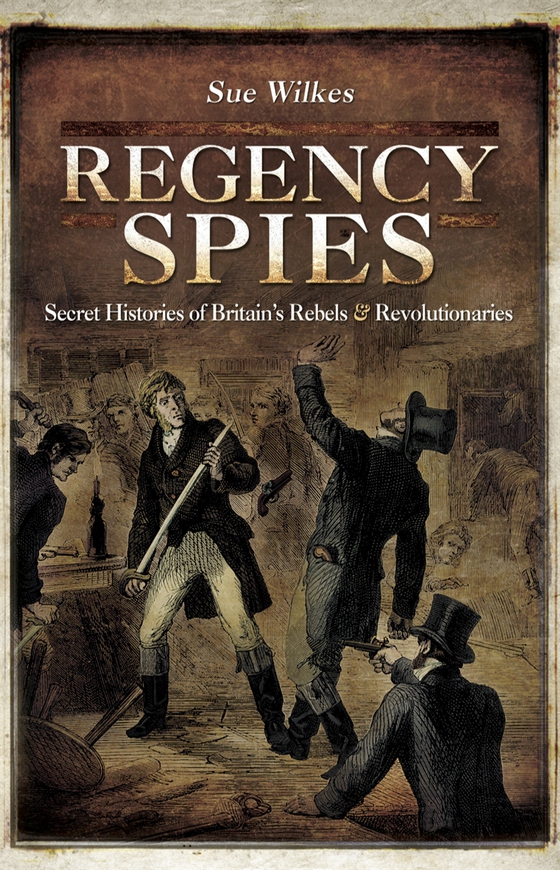
Regency Spies e-bok
109 kr
Sue Wilkes reveals the shadowy world of Britain's spies, rebels and secret societies from the late 1780s until 1820. Drawing on contemporary literature and official records, Wilkes unmasks the real conspirators and tells the tragic stories of the unwitting victims sent to the gallows. In this 'age of Revolutions', when the French fought for liberty, Britain's upper classes feared revolution was i…
Sue Wilkes reveals the shadowy world of Britain's spies, rebels and secret societies from the late 1780s until 1820. Drawing on contemporary literature and official records, Wilkes unmasks the real conspirators and tells the tragic stories of the unwitting victims sent to the gallows. In this 'age of Revolutions', when the French fought for liberty, Britain's upper classes feared revolution was imminent. Thomas Paine's incendiary Rights of Man called men to overthrow governments which did not safeguard their rights. Were Jacobins and Radical reformers in England and Scotland secretly plotting rebellion? Ireland, too, was a seething cauldron of unrest, its impoverished people oppressed by their Protestant masters. Britain's governing elite could not rely on the armed services – even Royal Navy crews mutinied over brutal conditions. To keep the nation safe, a 'war chest' of secret service money funded a network of spies to uncover potential rebels amongst the underprivileged masses. It had some famous successes: dashing Colonel Despard, friend of Lord Nelson, was executed for treason. Sometimes in the deadly game of cat-and-mouse between spies and their prey, suspicion fell on the wrong men, like poets Wordsworth and Coleridge. Even peaceful reformers risked arrest for sedition. Political meetings like Manchester's 'Peterloo' were ruthlessly suppressed, and innocent blood spilt. Repression bred resentment – and a diabolical plot was born. The stakes were incredibly high: rebels suffered the horrors of a traitor's death when found guilty. Some conspirators' secrets died with them on the scaffold... The spy network had some famous successes, like the discoveries of the Despard plot, the Pentrich Rising and the Cato St conspiracy. It had some notable failures, too. However, sometimes the 'war on terror' descended into high farce, like the 'Spy Nozy' affair, in which poets Wordsworth and Coleridge were shadowed by a special agent.
E-bok
109 kr



Förlag
Pen and Sword
Utgiven
15.02.2021
Längd
224 sidor
Genrer
Samhälle Och Politik, Fackböcker, Historia & Arkeologi
Språk
English
Format
epub
Kopieringsskydd
Vattenmärkt
ISBN
9781473878396
Sue Wilkes reveals the shadowy world of Britain's spies, rebels and secret societies from the late 1780s until 1820. Drawing on contemporary literature and official records, Wilkes unmasks the real conspirators and tells the tragic stories of the unwitting victims sent to the gallows. In this 'age of Revolutions', when the French fought for liberty, Britain's upper classes feared revolution was imminent. Thomas Paine's incendiary Rights of Man called men to overthrow governments which did not safeguard their rights. Were Jacobins and Radical reformers in England and Scotland secretly plotting rebellion? Ireland, too, was a seething cauldron of unrest, its impoverished people oppressed by their Protestant masters. Britain's governing elite could not rely on the armed services – even Royal Navy crews mutinied over brutal conditions. To keep the nation safe, a 'war chest' of secret service money funded a network of spies to uncover potential rebels amongst the underprivileged masses. It had some famous successes: dashing Colonel Despard, friend of Lord Nelson, was executed for treason. Sometimes in the deadly game of cat-and-mouse between spies and their prey, suspicion fell on the wrong men, like poets Wordsworth and Coleridge. Even peaceful reformers risked arrest for sedition. Political meetings like Manchester's 'Peterloo' were ruthlessly suppressed, and innocent blood spilt. Repression bred resentment – and a diabolical plot was born. The stakes were incredibly high: rebels suffered the horrors of a traitor's death when found guilty. Some conspirators' secrets died with them on the scaffold... The spy network had some famous successes, like the discoveries of the Despard plot, the Pentrich Rising and the Cato St conspiracy. It had some notable failures, too. However, sometimes the 'war on terror' descended into high farce, like the 'Spy Nozy' affair, in which poets Wordsworth and Coleridge were shadowed by a special agent.
Inga recensioner än