


Alex Revell
(författare)
Fall of Eagles e-bok
109 kr
The Great War of 1914-1918 saw the rapid development of the airplane as a weapon of war. Initially its role was seen as that of reconnaissance, an extension of the cavalry, but as the war stagnated into static trench warfare, with each side facing each other across No Man’s Land, the use of artillery, both in shelling enemy positions and counter-shelling his artillery, also became of prime …
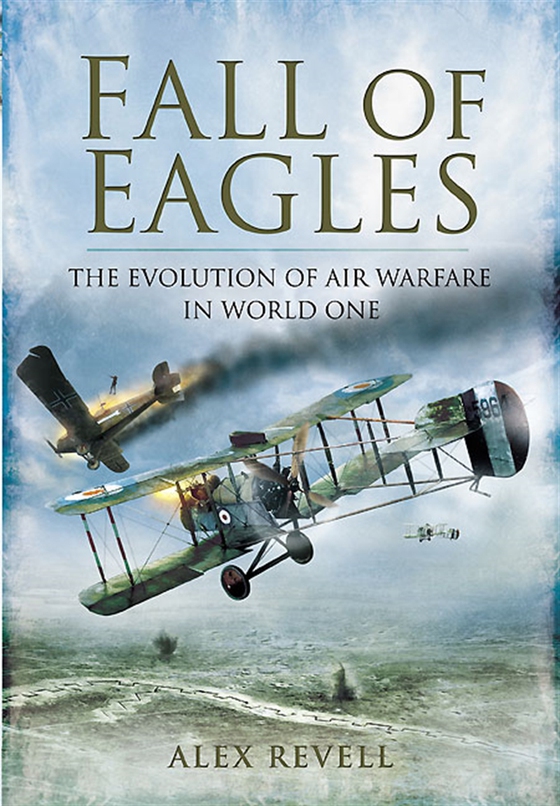
The Great War of 1914-1918 saw the rapid development of the airplane as a weapon of war. Initially its role was seen as that of reconnaissance, an extension of the cavalry, but as the war stagnated into static trench warfare, with each side facing each other across No Man’s Land, the use of artillery, both in shelling enemy positions and counter-shelling his artillery, also became of prime importance. With the early development of radio communication between ground and air, airplanes also undertook the task of ‘spotting’ for the artillery, and it soon became apparent that these airplanes – both the reconnaissance machines and those working for the artillery – could not be allowed to work unmolested, and fast fighter airplanes - both single and two seat – began to make their appearance over the Western Front. Technical development was rapid. The mostly unarmed reconnaissance airplanes, and the early fighters of 1915 and 1916, armed with a single machine gun, had given way to fighters carrying two guns, flying at altitudes of over 16,000 feet and at treble the speed of the predecessors of 1914. With these developments a new type of soldier had evolved: the fighter pilot. Capable of fighting in the air, in three dimensions and at great speed, individual pilots began to emerge whose singular talents and temperament brought them to the forefront of their respective air forces. They became the ‘aces’, pilots who had brought down five or more of the enemy. Despite their expertise, few of these ‘aces’ survived the war. The last combats of some are known and well documented, others are obscure. Some of the pilots in these pages are well-known, others less so, but all shared the common experience of fighting in the air during the war of 1914-1918: the conflict which saw the airplane evolve from a relatively fragile, unarmed reconnaissance machine, to a deadly weapon that changed the face of war for ever.
E-bok
109 kr
Förlag
Pen and Sword
Utgiven
23.02.2021
Längd
256 sidor
Genrer
Samhälle Och Politik, Fackböcker, Historia & Arkeologi
Språk
English
Format
epub
Kopieringsskydd
Vattenmärkt
ISBN
9781844684328
The Great War of 1914-1918 saw the rapid development of the airplane as a weapon of war. Initially its role was seen as that of reconnaissance, an extension of the cavalry, but as the war stagnated into static trench warfare, with each side facing each other across No Man’s Land, the use of artillery, both in shelling enemy positions and counter-shelling his artillery, also became of prime importance. With the early development of radio communication between ground and air, airplanes also undertook the task of ‘spotting’ for the artillery, and it soon became apparent that these airplanes – both the reconnaissance machines and those working for the artillery – could not be allowed to work unmolested, and fast fighter airplanes - both single and two seat – began to make their appearance over the Western Front. Technical development was rapid. The mostly unarmed reconnaissance airplanes, and the early fighters of 1915 and 1916, armed with a single machine gun, had given way to fighters carrying two guns, flying at altitudes of over 16,000 feet and at treble the speed of the predecessors of 1914. With these developments a new type of soldier had evolved: the fighter pilot. Capable of fighting in the air, in three dimensions and at great speed, individual pilots began to emerge whose singular talents and temperament brought them to the forefront of their respective air forces. They became the ‘aces’, pilots who had brought down five or more of the enemy. Despite their expertise, few of these ‘aces’ survived the war. The last combats of some are known and well documented, others are obscure. Some of the pilots in these pages are well-known, others less so, but all shared the common experience of fighting in the air during the war of 1914-1918: the conflict which saw the airplane evolve from a relatively fragile, unarmed reconnaissance machine, to a deadly weapon that changed the face of war for ever.
Inga recensioner än